How to Read Your Own Birth Chart, in Order
Photo: Wikimedia Commons (CC BY-SA 3.0)
Birth Charts

How to Read Your Own Birth Chart, in Order

Learn to read your birth chart in order: start with the signs, planets, houses, and aspects for a clear, step-by-step self-reading guide.

Manishankar5 min read

How to Read Your Own Birth Chart, in Order

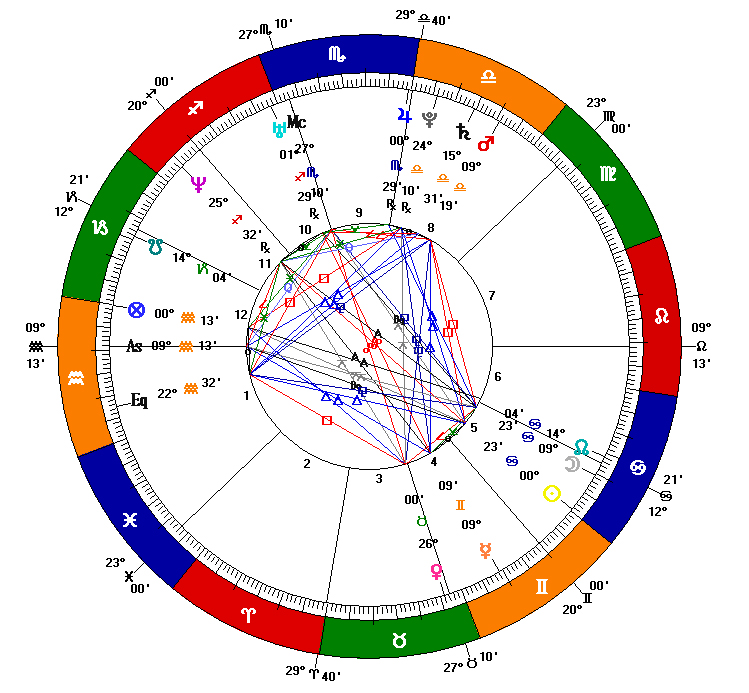
A birth chart is a snapshot of the sky at your first breath. Reading it well is about sequence, not speed. When you hold your chart wheel for the first time, the pull is to dive into the fine print, the obscure aspects and minor house placements. That approach produces a contradictory reading because it lacks context. The practical order for a beginner is this: start with the big three, then find your chart ruler, weigh element and modality balance, look at the loudest aspects, examine house emphasis, and save the fine detail for last. This sequence is how astrologers read a chart. It keeps every piece of information in its proper frame, so the story you build feels coherent rather than chaotic.

Start With the Big Three: Sun, Moon, and Rising

Your Sun sign is your core identity, the part of you that feels most like "you." Your Moon sign is your emotional interior, how you process feelings and what you need to feel safe. Your rising sign, also called your ascendant, is the mask you wear in the world. It shapes the first impression you make and the lens through which you experience new situations.

Advertisement[SIDEBAR_RIGHT_2]

Read these three first because they form the foundation of your personality. If you start elsewhere, the pieces will not feel connected. The Sun, Moon, and rising work together as a trio. A Sun in Leo with a Moon in Cancer and a Virgo rising is not a simple "Leo." They are a proud, warm presence who retreats to quiet emotional caregiving at home, yet presents to the world as composed and detail-oriented. That is the first layer. Write these three down in a sentence, and you have a working summary of who you are. Everything else in the chart, from the planetary placements to the house positions, is read in light of that summary.

Find Your Chart Ruler and Assess Element and Modality Balance

Your chart ruler is the planet that rules your rising sign. If your rising sign is Aries, your ruler is Mars. If it is Taurus or Libra, your ruler is Venus. If it is Gemini or Virgo, your ruler is Mercury. Cancer rules under the Moon, Leo under the Sun, Scorpio under Mars, Sagittarius under Jupiter, Capricorn under Saturn, Aquarius under Saturn, and Pisces under Jupiter.

Find where that planet sits in your chart, which sign and which house. That placement is considered a secondary focal point, a thread that runs through your life. If your ruler is in the tenth house of career, you may be read as someone who channels their identity through public achievement. If it is in the fourth house of home, your inner life may be more tied to family and roots than to ambition. The chart ruler is the bridge between your rising sign and the rest of the wheel, so it deserves attention before the finer points.

Advertisement[SIDEBAR_RIGHT_6]

After the ruler, step back and count the elements. Fire signs are Aries, Leo, and Sagittarius. Earth signs are Taurus, Virgo, and Capricorn. Air signs are Gemini, Libra, and Aquarius. Water signs are Cancer, Scorpio, and Pisces. Then count the modalities. Cardinal signs are Aries, Cancer, Libra, and Capricorn. Fixed signs are Taurus, Leo, Scorpio, and Aquarius. Mutable signs are Gemini, Virgo, Sagittarius, and Pisces. A chart heavy in fire and air is read as energetic and outward, while a chart heavy in earth and water is read as grounded and internal. An imbalance is not a flaw, it is a theme. A chart with no water, for example, is said to struggle with emotional expression. A chart with no earth is said to struggle with practicality. This balance gives you the texture of how your big three operate, and it is a useful lens for all the placements that follow.

Examine the Loudest Aspects and House Emphasis

Aspects are the angles between planets. The loudest ones are the conjunctions, where two planets sit close together, and the oppositions, where they face each other across the chart. Squares, where planets are about ninety degrees apart, are also hard to miss. These are the aspects that astrologers say create the most noticeable tension and drive.

Start with conjunctions. When two planets are together, their energies blend. When they are opposite, they pull in different directions, and you are read as someone who lives between two poles. Squares are friction points. They are not read as negative, they are read as motivators. Read the houses these aspects fall in, because the house tells you the life area where the tension shows up.

Advertisement[SIDEBAR_RIGHT_7]

Then look at house emphasis. Count which houses hold the most planets. Houses one through six are considered the personal half of the chart, and houses seven through twelve are the interpersonal and collective half. A chart full of planets in the personal houses suggests a life focused on self-development, daily routines, and close relationships. A chart full of planets in the outer half suggests a life focused on partnership, shared resources, and public contribution. Only after all of this do you look at the fine detail: the minor aspects like sextiles and trines, the slower-moving planets like Uranus and Neptune, and the specific degree positions. By that point you have a framework, so the details fit into a coherent story instead of contradicting one another. If a fine detail seems off, it is because you have not yet placed it in the context of the big three and the chart ruler. Go back to those first steps and the contradiction will usually resolve itself.

Reading your own chart is a skill that builds with repetition. The order is not arbitrary. It is a way of building understanding from the center outward. Start with the core, follow the ruler, map the balance, listen to the loud voices, and let the fine print wait its turn. Each pass over the chart deepens your familiarity. What once seemed like a jumble of symbols becomes a legible portrait of temperament and inclination. For a fuller picture, pair this sequence with an exploration of planetary dignity and the lunar nodes, which add another layer of nuance once the basics feel comfortable.

Today's Horoscope

September 24, 2026

All signs →

Get Your Horoscope in Your Inbox

A weekly note on your sign, the moon, and what the stars are up to. No spam, unsubscribe anytime.

We respect your privacy. Unsubscribe at any time.