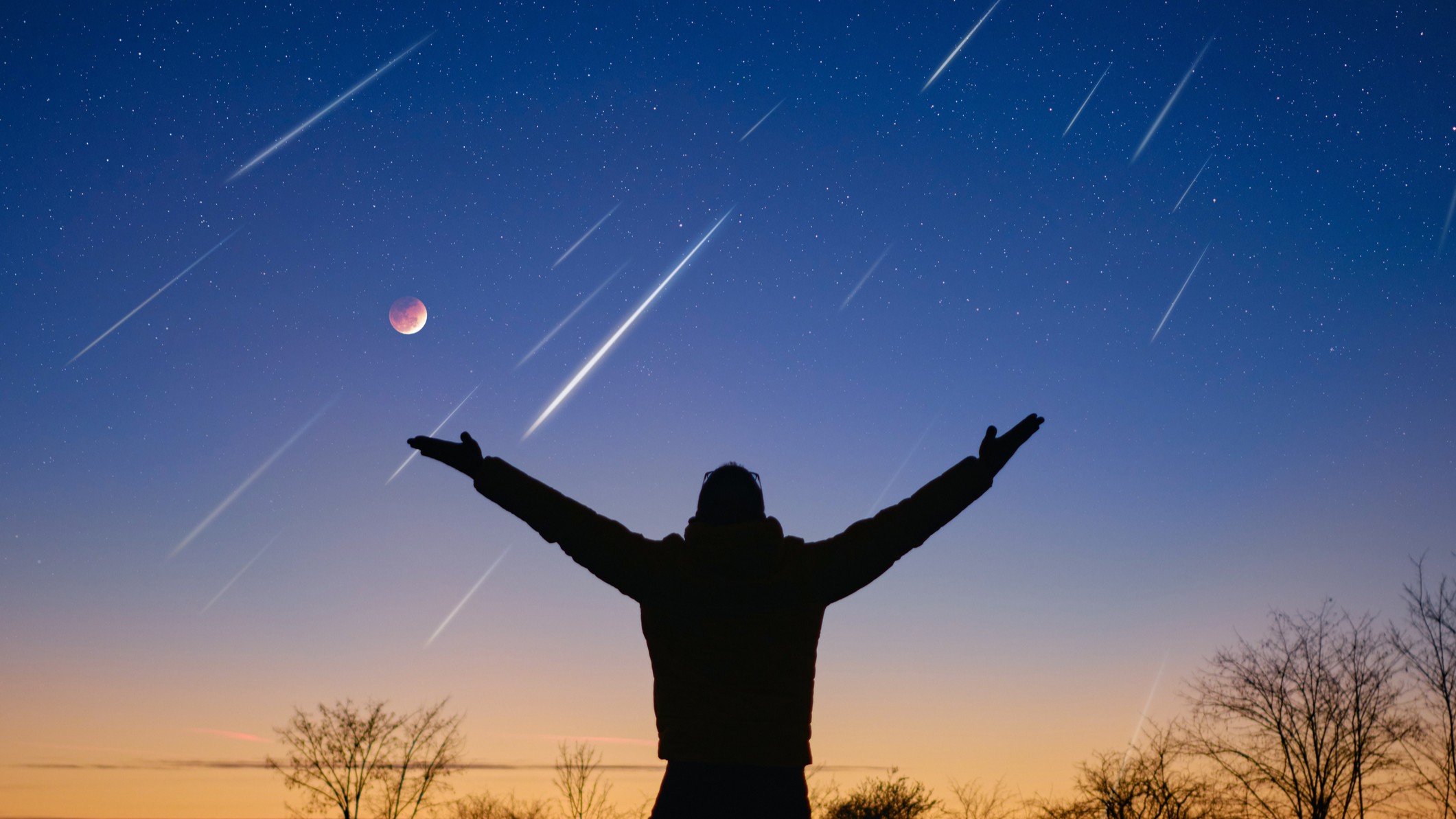
The Leonid meteor shower, one of the year's most celebrated annual displays, is expected to be notably weak in 2026, with long stretches likely to pass without a single meteor visible. The shower is named for its radiant point within the constellation of Leo the Lion, in the backward question mark pattern known as The Sickle. The meteors are caused by Comet Tempel-Tuttle, which sweeps through the inner solar system every 33⅓ years and leaves a dense trail of dusty debris in its wake each time it passes closest to the sun.
A meteor storm becomes possible if Earth scores a direct hit on a fresh dust trail ejected by the comet over the past several centuries. The bulk of comet dust is found just ahead of and trailing behind Tempel-Tuttle, which last swept through the inner solar system in 1998. That is why spectacular showers were seen in 1999, 2001 and 2002, with declining numbers thereafter.
According to the International Meteor Organization's 2026 meteor shower calendar, the Leonids are expected to reach their regular maximum at 23:45 UTC on Nov. 17, with around 15 meteors per hour possible under ideal viewing conditions. Margaret Campbell-Brown and Peter Brown, meteor experts for the Royal Astronomical Society of Canada, predict the peak will occur at 00:00 UTC on Nov. 18, while Russian meteor expert Mikhail Maslov places it about a third of a day earlier, at 16:00 UTC on Nov. 17. Several weaker encounters with older debris trails are also predicted between Nov. 17 and 19, though no major storm is expected.
Comet Tempel-Tuttle was as far from the sun as it can get, 1.84 billion miles, in September 2014, and has spent the last dozen years slowly approaching the inner solar system. It remains 1.11 billion miles from the sun, still well beyond the orbit of Saturn. At the point in the comet's orbit Earth will pass on Tuesday morning, there is nothing save for a scattered few particles, likely loosened from the comet's nucleus a millennium or two ago. This year's Leonids are expected to show only low activity, perhaps 10 to 15 per hour at best. The moon, at first quarter phase, will set before 11 p.m. local time Monday evening.
Leo does not start coming fully into view until after midnight, the best time to look for Leonids, and by about 5 a.m. the Sickle will have climbed more than two-thirds of the way from the southeast horizon toward the zenith. Because the Leonids travel in a direction opposite to Earth's, they slam into the atmosphere nearly head-on at 45 miles per second, producing bright meteors that leave long-lasting streaks or persistent trains. A mighty Leonid fireball can be spectacular, but such bright meteors are likely to be few and far between this year.
It was a different story 60 years ago, in 1966, when anticipation ran high for a heavy display. The previous year, comet Tempel-Tuttle swept around the sun and was accompanied by an unexpected surge of Leonid activity, with brilliant meteors at one or two per minute as seen from Hawaii and Australia. Dr. Kenneth L. Franklin, chief scientist at New York's Hayden Planetarium, examined the comet's orbit and concluded that its position was roughly what it had been in 1833, so a dramatic shower like that year's might be in the offing for 1966. A meteor party was planned for the peak night in Central Park, and ten thousand people turned out on the Great Lawn at midnight, but skies were hopelessly cloudy. Across the central and western US, where skies were mostly clear, Leonids fell at a rate many described as too numerous to count. From 6,850-foot Kitt Peak in southern Arizona, thirteen amateur astronomers saw Leonids falling at 40 per second, or 144,000 per hour. In 2005, French meteor expert Jeremie Vaubaillon published a technical paper with two colleagues in the journal Astronomy & Astrophysics forecasting Leonid activity up to 2100. In 2029, Jupiter is expected to throw Comet Tempel-Tuttle off its current path, making a repeat of the Great Leonid Storm of 1966 all but impossible at least through the beginning of the 22nd century, though Vaubaillon expects the next big outburst in 2034, when rates could reach up to 2,000 per hour.