
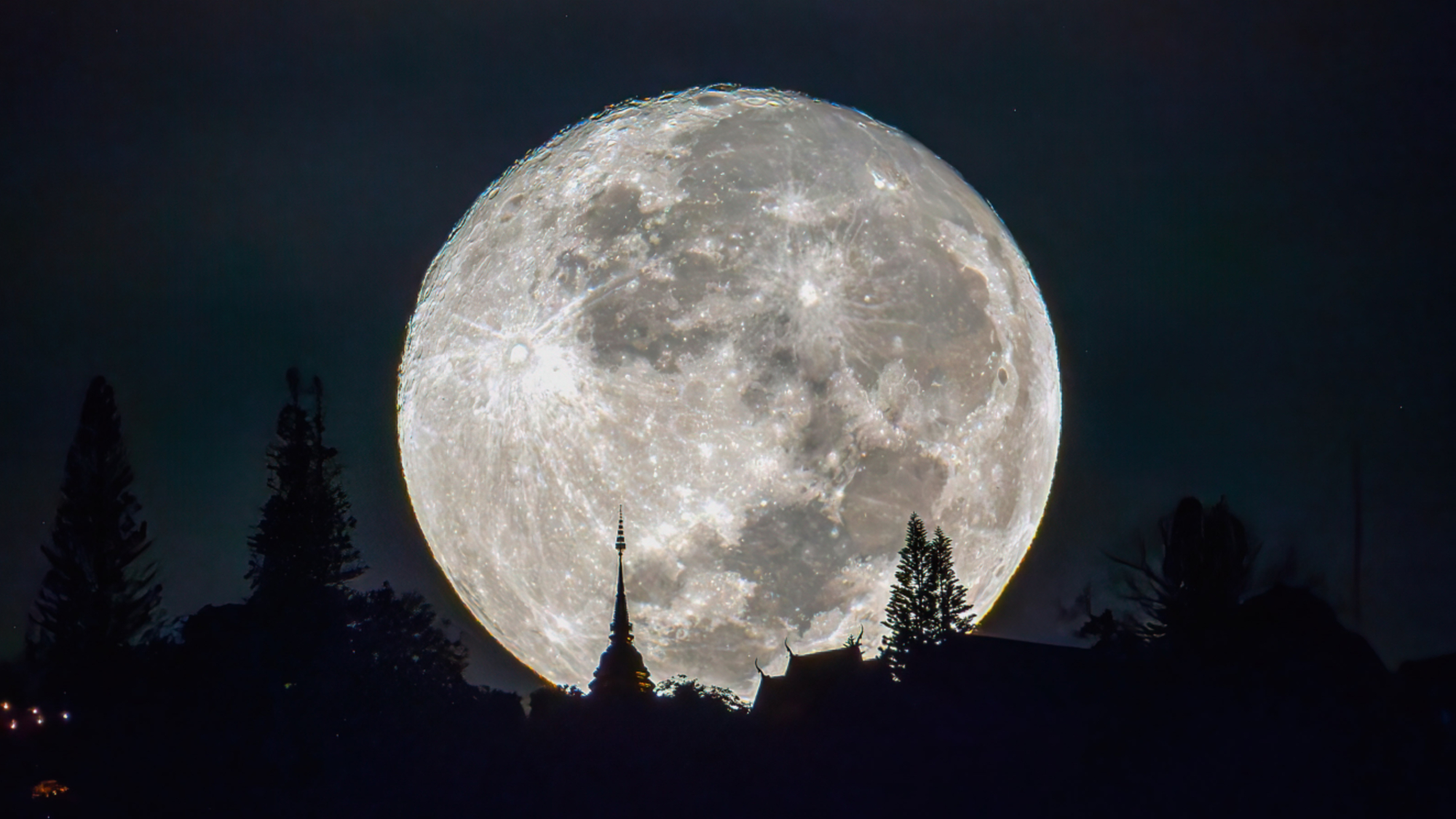
December's full moon will arrive close to perigee, the point in the moon's elliptical orbit nearest Earth, producing a supermoon that can appear 30% brighter and 14% larger than a full moon at its farthest point, known as a micromoon. According to the late astronomer Fred Espenak, the Cold Moon will be 221,667 miles (356,740 kilometers) from Earth when it turns full, making it the closest supermoon of 2026. The lunar disk will rise over the eastern horizon at sunset on Dec. 23, only hours before reaching maximum illumination. Time and Date's moonrise and moonset tracker offers timings for specific locations.
The moon may look larger than usual near the horizon, partly because it is close to perigee and partly because of the moon illusion, which leads observers to perceive the moon as bigger than it is when foreground objects are present. Around moonrise and moonset it may also take on a golden or orange hue, as low-horizon light passes through more of Earth's atmosphere, scattering shorter blue wavelengths and letting longer red wavelengths reach the eye.
The December full moon is commonly called the Cold Moon for the freezing temperatures that can arrive at this time of year. The Mohican tribe of North America knows it as the Long Night Moon, a name tied to its proximity to the winter solstice, the shortest day of the year in the Northern Hemisphere. Old English peoples called it the Moon Before Yule, according to Time and Date, while the Celts of Europe referred to it as the Oak Moon after traditions centered on the hardy trees.
The full moon also coincides with Datta Jayanti, the Hindu festival celebrating the birth of Lord Dattatreya, who embodies the trinity of Lord Brahma, Vishnu and Shiva, according to the Government of Maharashtra. It rises close to the Christian celebration of Christmas on Dec. 25, when followers mark the birth of Jesus Christ.
After rising, the Cold Moon will shine in the center of a Winter Hexagon of stars bright enough to cut through its glare. Observers can begin with Sirius, the brightest star in the night sky, which rises into the southeastern sky shortly after 8 p.m. local time for viewers in New York, then trace an imaginary line to the blue supergiant Rigel in Orion, hop to the orange glow of Aldebaran in Taurus, move on to Capella in Auriga, drop down to Pollux in Gemini and nearby Procyon, and close the loop back at Sirius.
Jupiter and the red light of Mars will shine low in the eastern sky in the hour before midnight, while Saturn lurks close to the western horizon. Venus will appear as a brilliant Morning Star in the southeast just before dawn, with the red giant Arcturus shining higher in the predawn sky near the constellation Bootes. The fully illuminated lunar disk offers a strong subject for photography, and apps such as Stellarium or SkySafari 7 Pro can help with viewing plans.