Venus is often described as Earth’s twin because of its similar size, mass, rocky composition, and distance from the sun, but it differs sharply in at least one visible way: it has no moon. Mercury, the closest planet to the sun, also lacks a moon, making those two the only planets in the solar system without one. Scientists have long wondered whether Venus ever had a natural satellite and lost it. A research team led by Stephen R. Kane of the University of California, Riverside has now modeled what would have happened to a hypothetical moon around Venus.
Kane said his interest stems from studying Venus’s evolution and its potential for past habitability. He noted that Venus and Earth are nearly identical in size, mass, and composition, yet Earth has a large moon and Venus has none, not even a small captured satellite. He added that Venus surely experienced large impacts just as Earth did, giving it as much or more opportunity to form a moon. The team built a simulation from fundamental physics and checked it by reproducing the evolution of the Earth-moon system.
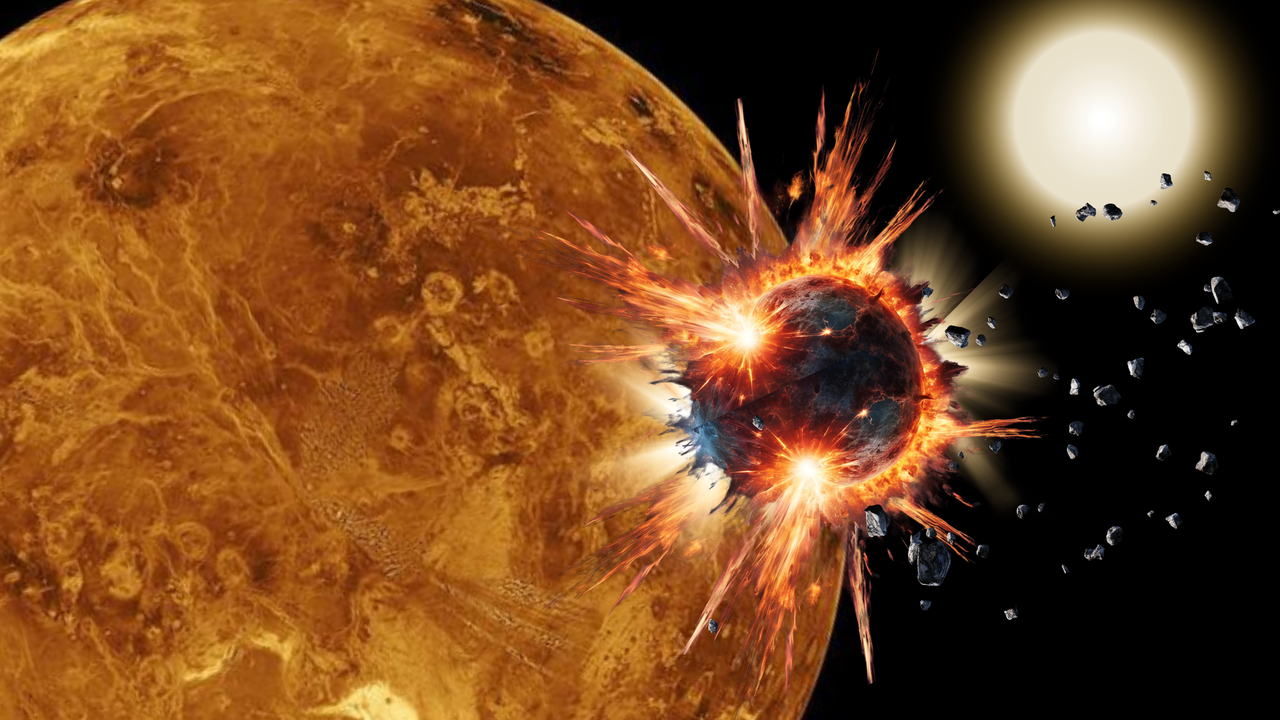
The simulation tracked a gravitational tug-of-war among Venus, a hypothetical moon, and the sun over billions of years. Kane explained that the same physics governs Earth’s moon, which is slowly moving away from our planet. The researchers tested a wide range of starting conditions for Venus’s spin rate and the moon’s mass, using two independent mathematical descriptions of tides. In most cases, they found that a Venusian moon would not drift outward safely like Earth’s moon does. Instead, the moon would eventually reverse course, spiral inward, and be torn apart by Venus’s gravity.
The team also found that a larger moon would not be safer. Kane said a heavier moon would be destroyed faster because it would drain Venus’s spin so efficiently that it would hasten its own doom. Survival depended on two main factors: Venus had to be spinning fast when the moon formed, with a day shorter than about 12 hours, and the moon could not be too massive, up to roughly the mass of our own moon. Under those narrow conditions, the moon would migrate outward and stabilize. Outside that range, the moon would be consumed by Venus.
Kane concluded that a surviving moon would have had to be modest in size and orbit a rapidly spinning early Venus, conditions that do not match what scientists think early Venus was actually like. He acknowledged that direct observational evidence will be hard to find, since a moon lost billions of years ago would leave little trace that telescopes could detect today. However, he pointed to indirect avenues, such as chemical fingerprints in Venus’s surface or atmosphere from moon debris raining down. Upcoming missions, including NASA’s DAVINCI probe, will measure the planet’s atmospheric composition in detail.
Kane said that better knowledge of Venus’s interior would improve models like his, since the outcomes depend on interior properties that are not well understood. He also noted a broader test beyond the solar system: the results predict that slowly rotating, Venus-like planets around other stars should generally lack large moons, a prediction that astronomers can check as they search for moons around exoplanets. He plans to explore the compositional and atmospheric effects of a Venusian moon consumption event, which may be testable, and to study similar scenarios for Mercury and Mars. The team’s research has been posted on the repository site arXiv as a pre-peer-reviewed paper.