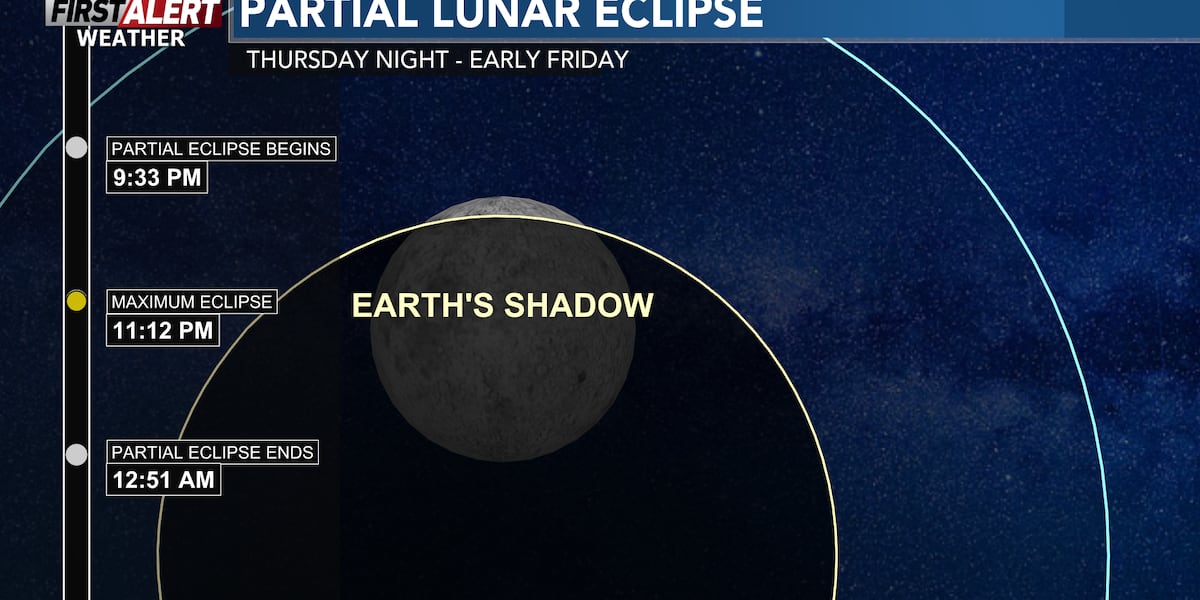
The upcoming lunar eclipse will be visible across a vast portion of the globe, with nearly the entire lunar surface passing through Earth’s shadow. The event will peak at 11:12 p.m. CDT, and because the moon will be 96% obscured, it is considered an especially deep partial eclipse. During the peak, the moon is expected to take on a copper or reddish hue, a phenomenon often called a blood moon. This coloration occurs because sunlight bends through Earth’s atmosphere, which filters out most blue light and allows the redder "sunset to sunrise" light to reach the lunar surface. Unlike a total eclipse, this alignment will not be perfect, so it will not be a true blood moon.
In addition to the eclipse, a coronal mass ejection, or CME, is expected to strike Earth on Thursday night. This solar event could make the Northern Lights visible across the northern tier of the United States. Normally, a full moon would wash out the aurora, but since Earth’s shadow will be cast across the moon, the lights may still be seen late Thursday night into early Friday morning. The partial phase of the eclipse will last more than three hours, while the entire event, from the moon entering the faintest edge of Earth’s shadow to its exit, will span about five and a half hours.
The eclipse follows a total solar eclipse that passed through Greenland, Iceland, and Spain two weeks earlier. Eclipses occur in pairs because the sun, moon, and Earth align so precisely that one obscures the other. This is aided by a cosmic coincidence: the moon is 400 times smaller than the sun, but the sun is 400 times farther away, making them appear the same size in the sky. This lunar eclipse will have a much larger audience than the recent solar one, with visibility expected across North and South America, Europe, Africa, and the Middle East, weather permitting.
Nearly 1 billion people in the U.S., Canada, and Central and South America will have front-row views for the entire eclipse. More than 3 billion people, or 44% of the world’s population, will be in position to see at least part of it. This is the year’s second lunar eclipse and the fourth eclipse overall. A total lunar eclipse was seen over the Americas, Australia, and eastern Asia in March. The next complete lunar blackout will not occur until New Year’s Eve 2028, with Asia and Australia at center stage, and stargazers in North and South America will wait until 2029 for another full eclipse.
The moon has already drawn attention this year, as NASA sent the Artemis II astronauts on a record-breaking lunar flyby in April. That mission is a prelude to eventual landings and the construction of a base on the moon. NASA astronaut Jack Hathaway said from the International Space Station that this is a great time to be part of the space program and that the pace is not slowing down. The space station’s commander, Jessica Meir, noted that space offers a unique perspective for viewing cosmic events like eclipses and auroras. The eclipsed moon may also be visible to the eleven people living off the planet, including seven astronauts on the International Space Station and three aboard China’s orbiting outpost.