
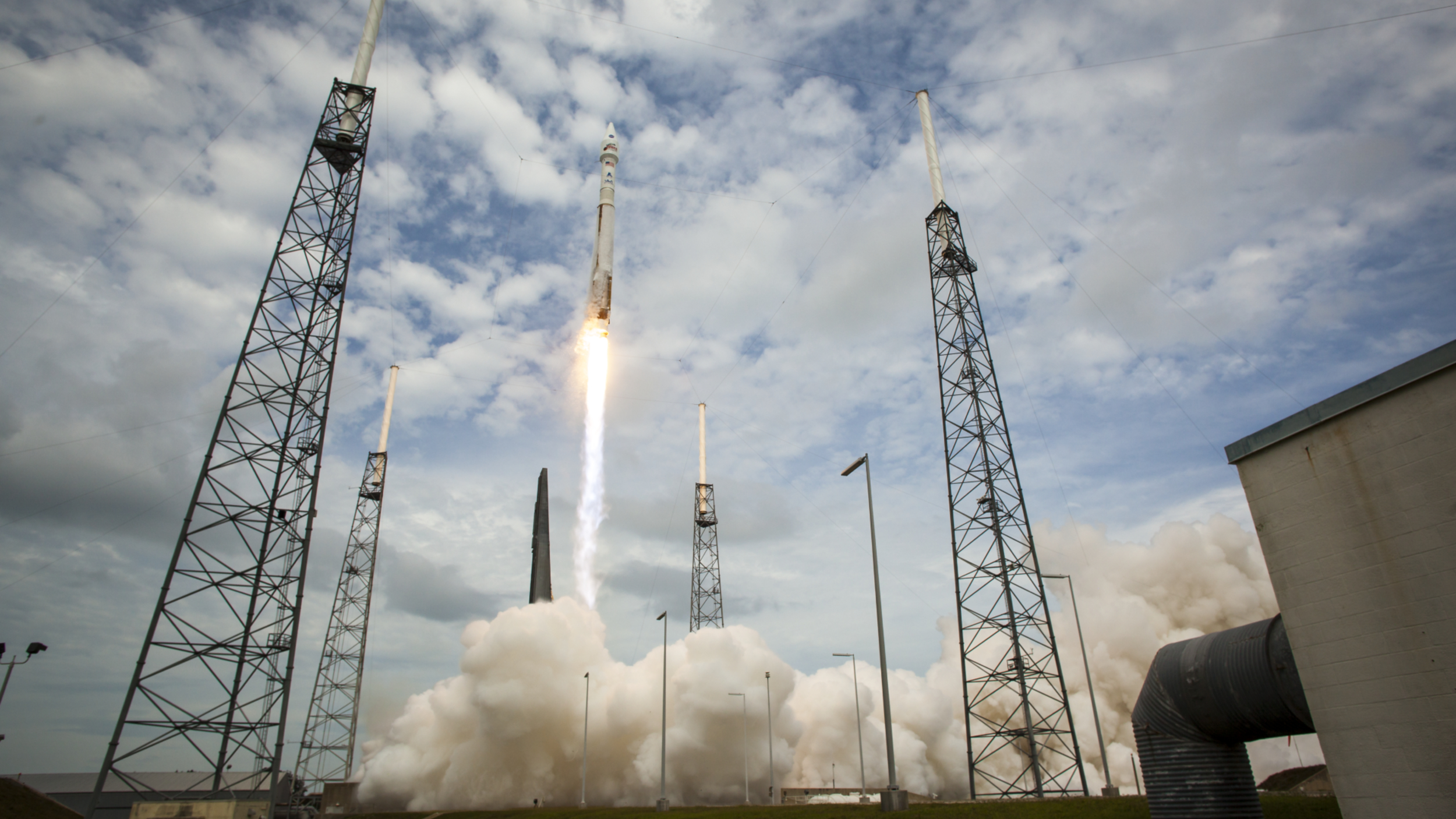
NASA launched its MAVEN spacecraft toward Mars on Nov. 18, 2013, beginning a mission to understand how the Red Planet lost its water and its atmosphere. The name MAVEN stands for Mars Atmosphere and Volatile EvolutioN. The orbiter was built to help scientists work out what became of the Martian atmosphere and water.
Mars is dry today, but data from several Mars missions indicate that the planet was once much wetter. The planet's atmosphere is extremely thin and has been leaking into space for a few billion years. Scientists believe that when Mars lost its atmosphere, water on the surface dried up as a consequence.
Solar storms that send radiation through the solar system appear to have carried away some of the atmosphere. Carbon dioxide in the atmosphere once kept Mars warm enough for liquid water to exist on its surface, and the loss of that greenhouse gas turned Mars cold and dry. MAVEN was the first Mars orbiter ever built to measure how the Martian atmosphere interacts with solar wind, the constant stream of particles from the sun, and how that stream gradually stripped the planet of its atmosphere over time.
After launching in 2013, MAVEN spent about 10 months traveling to Mars before entering orbit on Sept. 21, 2014. The spacecraft then spent the better part of 11 years studying the Red Planet from orbit with three different suites of instruments. These were an imaging ultraviolet spectrograph to study the global characteristics of the Martian atmosphere, a Neutral Gas and Ion Mass Spectrometer to measure its composition, and a six-instrument setup to study how Mars' ionosphere reacts to solar wind.
Louise Prockter, NASA director of planetary science, said in June 2026 after the mission concluded that the science MAVEN provided is key to informing what kind of radiation protection and safety measures must be taken before sending humans to Mars. She also said the data collected from MAVEN will continue to provide valuable insight into Mars for decades to come.
MAVEN was originally designed to study Mars for one full Earth year after arriving at the Red Planet. That mission ended in 2016, but the spacecraft managed to survive for another 10 years, adding more observations for scientists to study. As the orbiter aged, NASA ultimately began using MAVEN as a communications relay for other missions at Mars. In December 2025, MAVEN went silent, and NASA lost communication with the orbiter.
An investigation later found that the probe sent its final signal on Dec. 6, 2025, as it was heading behind Mars as seen from Earth. When it emerged on the other side, it had gone into an uncontrollable spin that led to a loss of power, dooming the spacecraft. NASA tried in vain to recover the spacecraft over several months and ultimately declared the mission over in June 2026. Shannon Curry, MAVEN's principal investigator, called it the best Mars mission ever and said the team really experienced the loss of a loved one with the end of the mission.