
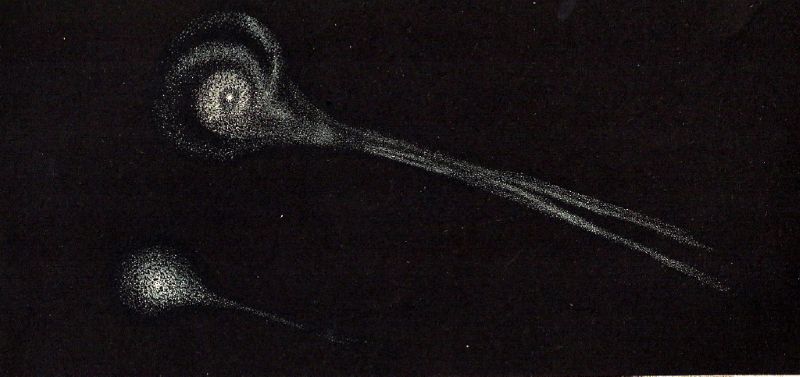
The Andromedid meteor shower, which peaks in late November, is now so faint that it cannot be seen without a telescope or binoculars. Two hundred years ago, however, the shower produced two spectacular meteor storms before largely vanishing. The shower is linked to what amounts to the ghost of a comet.
Biela's Comet was a regular visitor to Earth's skies in the late 1700s and early 1800s. French astronomer Jacques Laibats-Montaigne first recorded it in 1772. Austrian astronomer Wilhelm von Biela later recognized, in 1826, that the comet returned every 6.6 years, and his predictions gave the comet its name.
When Biela's Comet returned in 1846, it put on a shocking show. According to The Facts on File Dictionary of Astronomy, the comet first appeared distinctly pear-shaped and then split in two about 10 days later. The two halves continued traveling almost in the comet's original orbit, with one about 174,000 miles (280,000 km) behind the other, and the brightness of each half fluctuated wildly. The Dictionary of Astronomy reports that at the next return in 1852, their separation had increased eightfold and the two periods differed by about 15 days.
While Biela's Comet, or comets, may be gone, the meteor shower they spawned remains. The Andromedids, sometimes called the Bielids, form an annual meteor shower in late November. Its radiant, the spot the meteors appear to radiate from, lies in the constellation Andromeda the Chained Lady. The meteoroid stream, or the trail of pebbles left behind, follows the same orbit the comet had, which is how the shower is known to be related to the ghost of Biela's Comet.
Biela's Comet produced two meteor storms, which are especially strong showers that yield at least 1,000 meteors per hour. That happened on November 27 of 1872 and again in 1885. The 1885 meteor storm was incredibly strong, with reports of 75,000 meteors an hour. The shower has been much quieter ever since, and the few meteors it produces today are generally so dim that they are not visible to the eye alone.
The late November Andromedid meteor shower is thus the product of the ghost of Biela's Comet, which stunned observers in the 1800s when it broke up and then produced meteor storms.