
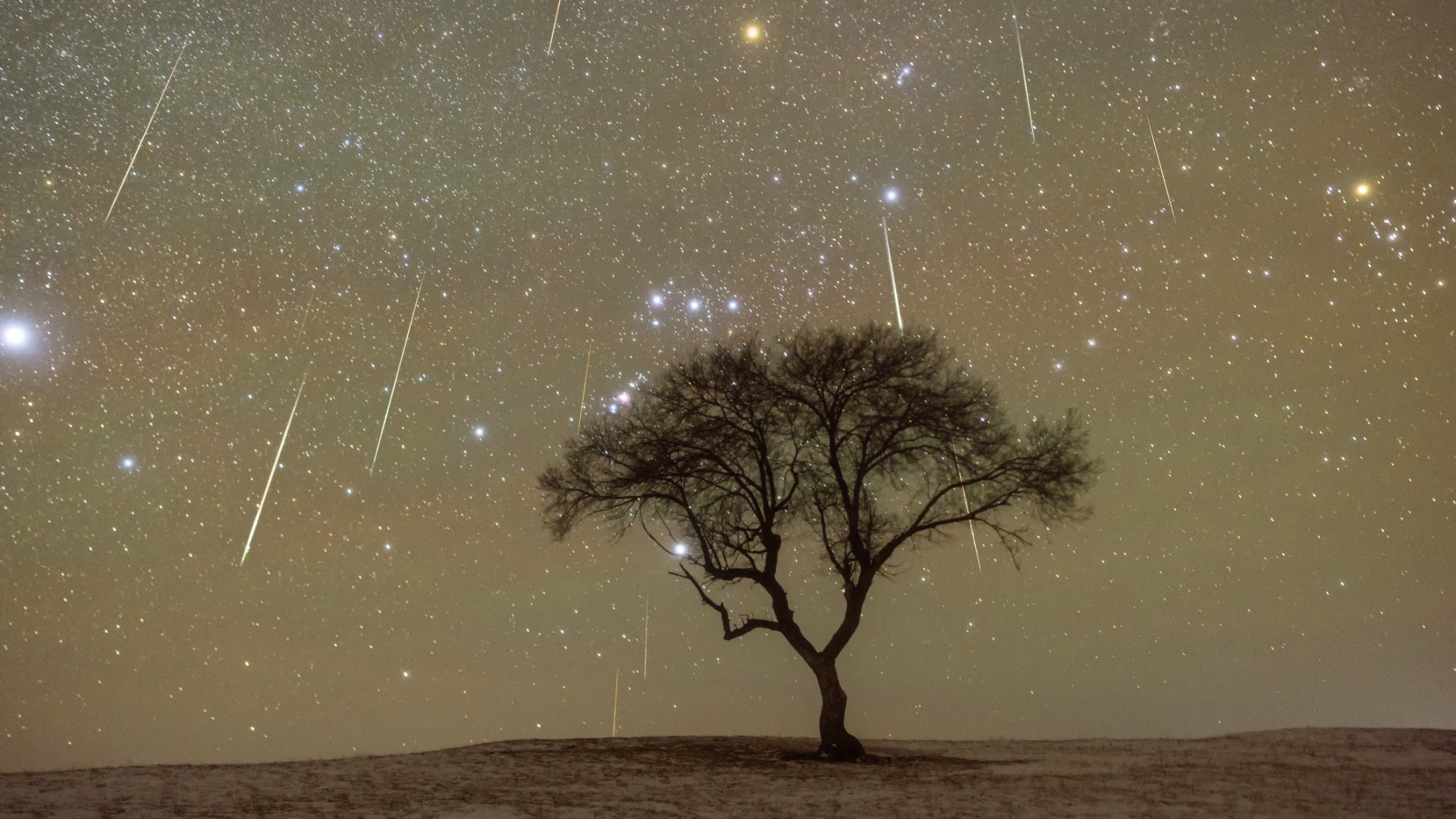
The Orionids peak next week, and the shower carries an appealing connection: its meteors come from debris shed by Halley's Comet. This year, however, a large, bright waxing gibbous moon will light the night sky and make shooting stars difficult to see. The shower remains observable, though a narrow window exists when moonlight will be absent. That dims the appeal of sacrificing a full night to it, including camping under a dark sky far from light pollution. Knowing when not to observe is an underrated stargazing skill.
The Orionids are active from Oct. 2 through Nov. 7, with the 2026 maximum expected overnight on Oct. 21-22. The meteors appear to radiate from a point near Orion, although they can streak across almost any part of the sky. Earth crosses the debris stream left by Halley's Comet, which was last in the inner solar system in 1986 and will return in 2061. Those particles strike the atmosphere at roughly 41 miles (66 kilometers) per second, making the Orionids particularly fast.
Under ideal conditions, the International Meteor Organization gives the shower a zenithal hourly rate of 20 or more around maximum. That figure is not a promise that an observer in a backyard will personally see 20 meteors in an hour. It assumes an excellent dark sky, a well-placed radiant and unobstructed viewing, which is impossible in practice. This year adds another complication: the moon reaches first quarter on Oct. 18 and continues waxing toward full on Oct. 26. On the peak night, an 80%-illuminated waxing gibbous moon will be in the sky as darkness falls on Oct. 21 and sets around 03:00 a.m. local time across Europe and North America on Oct. 22.
Sunrise is roughly 06:30 a.m. local time, meaning astronomical darkness, when the sun is more than 18 degrees below the horizon, lasts until around 05:00 a.m. local time. Those times are a ballpark, and exact moonset and sunrise times for a given location can be checked on Time and Date. A dark window therefore exists before dawn, and that is when an attempt to see the shower would make sense. The Orionid radiant is also much better placed after midnight than in the evening.
After checking the moon phase and the moonset and sunrise times, one more variable remains: the weather forecast. If the forecast is excellent, the period after moonset and before morning twilight on Oct. 22 is the target. If clouds are due, staying in bed is the plan. Beginners are sometimes given the impression that successful stargazing requires heroic commitment, but it does not. A meteor shower is not a performance that vanishes the moment the advertised peak passes, and the Orionids have a relatively broad period of activity, so meteors can appear on nights either side of maximum.
The moon reaches first quarter on Oct. 18, making stargazing tricky this week. Rather than writing the week off, the moon itself becomes an excellent early-evening target around first quarter. Sunlight strikes the lunar landscape along the terminator, the boundary between lunar day and night, throwing mountains and crater rims into strong relief. Cheap binoculars can reveal a surprising amount, and a telescope allows hours spent on the Montes Apenninus mountain range and three nearby craters: Eratosthenes and Archimedes on either side, and Plato above. Saturn remains another easy evening target after its Oct. 4 opposition, visible as a steady yellowish light toward the eastern and southeastern sky after dark, and even a modest telescope pointed at its rings will astound.
Cassiopeia is among the easiest constellations to find because its five main stars form a conspicuous W, or right now something that looks more like an M. It appears toward the northern sky in the evening, and from mid-northern latitudes it is high and prominent during autumn, on the opposite side of Polaris from the Big Dipper. That relationship is more useful than memorizing which way the W should point. Cassiopeia circles Polaris as Earth rotates, so its orientation changes through the night, and from sufficiently northerly locations it is circumpolar, never setting below the horizon.